Presidential & National Assembly elections:
- 00Days
- 00Hrs
- 00Mins
- 00Sec
Counting Down to the Next Election
Get Involved.... Let your votes Count; Who leads you matters!!!.
Governorship & State Houses of Assembly elections:
- 00Days
- 00Hrs
- 00Mins
- 00Sec


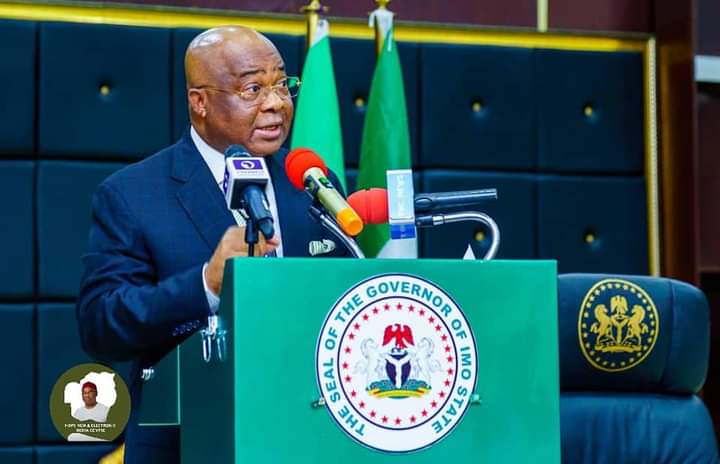
Senator Hope Odidika Uzodimma, CON, is a Nigerian politician and businessman currently serving his second and final term as the Executive Governor of Imo State. Since his re-election in November 2023, his administration has been defined by a shift toward digital innovation and aggressive infrastructure expansion under his “Shared Prosperity” agenda.
Family
Hope Uzodinma was born on 12 December 1958 in Omuma; his father Chief Michael Uzodinma held the chieftaincy title of Igwe of Ozuh Omuma and his mother was Ezinne Rose Uzodinma (née Nneoha). He is a kinsman of the Okoro family of Etiti-Omuma. Uzodinma is a devout Catholic, and is married to Chioma Uzodinma with seven children.
Background
He holds a Diploma in Maritime Management Technology, and Higher Diploma in the same field, from the Federal University of Technology Owerri. He also has a bachelor’s degree in International Studies and Diplomacy from Washington University in St. Louis. Prior to his entry into politics, Uzodinma was a businessman with vast business interests. He had the ceremonial title of Onwa-Netiri Oha of Omuma in Oru local government of Imo State.
Hope Uzodinma began his political career during the Second Nigerian Republic, joining the ruling National Party of Nigeria (NPN), where in 1983, he became the Imo State youth leader. In the 1990s, with the aborted transition to the Third Nigerian Republic, Uzodinma featured prominently as a member of the United Nigeria Congress Party.
Politics
In 1999, after the return to democracy, Uzodinma joined the People’s Democratic Party (PDP), where he served as a member of the party’s National Caucus, National Executive Committee and on the Board of Trustees, at various times between 1999 to 2017. As a party boss in Imo State, Uzodinma was a close associate of the Governor Achike Udenwa until late 2002, when ahead of the April 2003 elections he decamped to the Alliance for Democracy (AD), becoming the party’s candidate for the Imo State gubernatorial election. After losing the election to Udenwa, he returned to the PDP in February 2004. He later contested the PDP governorship primaries in December 2006, coming in second to Senator Ifeanyi Araraume. In 2011, after the incumbent Governor Ikedi Ohakim joined the PDP, Uzodinma endorsed him to run for a second-term as Governor of Imo State, favoring him over Rochas Okorocha who he later won.
In January 2011, Uzodinma won the PDP senatorial primary for the Imo West, gaining 2,147 votes, while the incumbent Senator Osita Izunaso came second with 891 votes. Uzodinma was later disqualified by a federal high court judgment as he had not been cleared by the PDP electoral panel led by Nwafor-Orizu. In March 2011, a court of appeal issued a stay of execution while the case was being decided, leaving Uzodinma free to campaign. On 5 April 2011 the Court of Appeal upheld the federal high court judgement, Uzodinma later appealed this decision at the Supreme Court. In the April 2011 elections, Uzodinma received 85,042 votes, ahead of former Governor Achike Udenwa of the Action Congress of Nigeria (ACN) with 64,228 votes and Rajis Okpalan Benedicta of the All Progressives Grand Alliance with 57,110 votes. In May 2011, the Supreme Court overturned the earlier decisions and declared that Uzodinma was the valid candidate and therefore had been elected.
Senator
On 29 May 2011, Uzodinma was sworn-in as a Senator of the Federal Republic of Nigeria, representing Imo State (West Senatorial District). He was re-elected for a second term in the Senate during the 2015 election. In 2018, he left the Peoples Democratic Party and joined the ruling All Progressive Congress (APC) in order to contest for Governor of Imo State in the 2019 general elections.
Governor of Imo State
In March 2019, the Independent National Electoral Commission sitting in Imo announced the governorship election results of Imo State: Emeka Ihedioha of the PDP who won with 273,404 votes, Uche Nwosu of Action Alliance with 190,364 votes, Ifeanyi Ararume of the All Progressives Grand Alliance with 114,676 votes; and Uzodinma in fourth place with 96,458 votes. Uzodinma later challenged the victory of Ihedioha up to the Supreme Court. On 14 January 2020, the Supreme Court declared Uzodinma, the duly elected Governor of Imo State. The court held that results from 388 polling units were wrongly excluded from votes ascribed to Uzodinma and the APC in Imo adding that the first appellant Uzodinma holds the majority of lawful votes cast.
On 15 January 2020, he and Placid Njoku were sworn-in as the Governor of Imo State and Deputy Governor of Imo State respectively In his inaugural address, he ordered the states accountant general to provide a comprehensive financial status for the state from May 2010 to January 2020, he also ordered the permanent secretaries of all ministries in the state to forward the status of all contracts awarded, whilst halting the paying for all ongoing contracts.
Governor Hope Uzodimma’s governance is guided by a strategic blueprint known as the “Shared Prosperity” Agenda, which is anchored on his 3R Initiative: Reconstruction, Rehabilitation, and Recovery.
For his second term (2024–2028), his manifesto expanded into a 10-Year Development Plan designed to move Imo State from a consumer-based economy to a production-driven one.
The manifesto is built on three central promises that dictate how every project is selected and funded:
Reconstruction: Focusing on physical infrastructure, specifically “quality roads that outlast the administration” and the modernization of urban centers.
Rehabilitation: Revitalizing the civil service, the health sector, and broken public utilities (like water and electricity).
Recovery: A controversial but central pillar focused on “recovering” state assets and land allegedly misappropriated by previous administrations.
A major shift in his second-term manifesto was the promise to make Imo the “Digital Hub of West Africa.”
Goal: Train 300,000 youths in high-level digital skills (AI, UI/UX, Data Analytics) by 2027.
Mechanism: Turning the state into a “Start-up State” by providing graduates with tools and seed funding.
Uzodimma’s manifesto places heavy emphasis on the dredging of the Orashi River to the Atlantic Ocean.
Goal: To create a Free Trade Zone and an Inland Port.
Impact: He promises this will unlock the state’s gas deposits and create a maritime corridor, ending Imo’s status as a landlocked state.
The manifesto outlines a “Farm-to-Table” strategy to ensure food security.
Goal: Revitalize the Adapalm plantation and other state-owned agro-industries.
Incentives: Providing subsidized fertilizers and mechanized equipment to rural farmers to boost exports.
Recognizing that industry cannot thrive without power, the manifesto includes a transition to the “Light Up Imo” project.
Goal: Utilizing the state’s natural gas to power Owerri and industrial clusters independently of the national grid.
Health: Implementing a statewide Health Insurance Scheme to provide affordable care for the vulnerable.
Housing: Constructing 5,000 affordable housing units for civil servants and low-income earners.
A critical part of his manifesto is the “Community Policing and Intelligence-Led Security” model. He promised to restore the state’s economy by first ensuring safety through:
Aggressive deployment of technology (CCTV and drones).
Strengthening the Ebubeagu (and subsequent state-aligned) security outfits.
A “no-compromise” stance on non-state actors to ensure a 24/7 economy.
“My vision is an Imo State where the wealth of the state is shared among all citizens through quality education, accessible healthcare, and a thriving economy, rather than being concentrated in the hands of a few.” — Governor Hope Uzodimma
As of April 2026, Governor Hope Uzodimma’s “journey so far” is often described by his supporters as a “Harvest of Results.” Having crossed the six-year mark of his administration, the focus has shifted from stabilizing the state to executing massive legacy projects and record-breaking social welfare reforms.
Here is a summary of the journey as it stands today:
The most visible aspect of his journey has been the dualization of major corridors that connect Imo to its neighbors.
Legacy Roads: The completion of the Owerri-Orlu, Owerri-Okigwe, and the Owerri-Mbaise-Obowo-Umuahia roads has significantly improved regional trade.
The Skyline Shift: In late 2025, the Assumpta Twin Flyovers were commissioned, unblocking the city’s most notorious traffic bottleneck.
Urban Renewal: Owerri has seen a facelift with the commissioning of the Heartland Resort Park and the Emmanuel Iwuanyanwu International Convention Centre (EIICC), restoring the city’s status as a hospitality hub.
Perhaps his most popular initiative, the digital empowerment of youth has transitioned from a pilot program to a cornerstone of the state’s economy.
50,000 Graduates: By early 2026, over 50,000 youths have been trained in software engineering, AI, and cybersecurity.
Innovation Hubs: The National Universities Commission (NUC) recently approved the Imo State University of Innovation, Science and Technology, Omuma, which now serves as the academic engine for these digital hubs.
In a move that surprised many national observers, Uzodimma implemented some of the most aggressive worker welfare policies in Nigeria:
₦104,000 Minimum Wage: Introduced in August 2025, this remains one of the highest sub-national wages in the country.
13th Month Salary: The administration has maintained the tradition of paying a 13th-month bonus to civil servants.
Gratuity Arrears: Released ₦16 billion in late 2025 to clear long-standing gratuity debts for retirees.
Health Insurance: The Imo State Health Insurance Agency now covers a record number of residents, focusing on reducing maternal mortality and providing free care to the vulnerable.
Light Up Imo: The Orashi Electricity Company has begun providing steady power to parts of the Obalende/Owerri metropolis, with plans for statewide expansion using the state’s natural gas reserves.
The governor’s journey was initially plagued by severe insecurity. By 2026, the narrative has shifted:
Restored Nightlife: Through the Imo State Vigilance Services and increased tech surveillance, the state has seen a significant return of nightlife and investor confidence.
Regional Leadership: His role as the Chairman of the Progressive Governors Forum has elevated his influence, allowing him to advocate for Southeast regional security at the federal level.
Governor Uzodimma has labeled 2026 the year of “Massive Harvest.” With a ₦1.44 trillion budget signed for this fiscal year, his administration is racing to complete the dredging of the Orashi River to the Atlantic Ocean—a project he believes will be his ultimate legacy, turning Imo into a maritime and gas power.
While critics still point to the high cost of these projects and the impact of earlier demolitions, the general consensus in early 2026 is that the “3R” mantra has moved from a slogan to a tangible physical reality across the state.
Governor Hope Uzodimma’s leadership milestones as of April 2026 reflect a dual focus: entrenching his “3R” agenda within Imo State and expanding his influence as a central figure in Nigeria’s national political landscape.
Here are the defining milestones of his leadership over the last few years:
Chairman, Progressive Governors Forum (PGF): Since 2023, Uzodimma has led the umbrella body of all APC governors. He is credited with fostering party harmony and aligning state-level policies with the federal government’s “Renewed Hope” agenda.
Renewed Hope Ambassador: In November 2025, President Tinubu appointed him as the Renewed Hope Ambassador and Director-General for Party Outreach. In this role, he leads the nationwide mobilization effort to communicate federal achievements to the grassroots across all 8,809 electoral wards.
Southeast Regional Unifier: As Chairman of the South East Governors Forum, he has been a key advocate for the South East Development Commission (SEDC) and has spearheaded regional security collaborations to restore peace to the zone.
His administration has received significant international and national acclaim for “measurable progress”:
Face of Africa Leadership & Governor of the Year (2026): Awarded by the London-based Triangle International Magazine in April 2026 for his strategic foresight in infrastructure and power.
Digital Governor of the Year: Recognized by multiple bodies (including NITMA and Vanguard) for the SkillUp Imo project, which transitioned thousands of youths from “tricycling to coding.”
Honorary Doctorate (FUTO): In December 2024, the Federal University of Technology, Owerri, conferred on him an Honorary Doctorate in Management for his leadership in state administration.
Minimum Wage Leadership: In 2025, he set a national benchmark by implementing a ₦104,000 minimum wage, coupled with the regular payment of a 13th-month salary for civil servants.
Fiscal Transparency: Received commendation from the Institute of Chartered Accountants of Nigeria (ICAN) for automating the state payroll and significantly increasing Internally Generated Revenue (IGR) through digital efficiency.
Security Restoration: The inauguration of the Imo State Vigilance Services and the deployment of AI surveillance are cited as milestones that successfully revived the state’s nightlife and investor confidence by early 2026.
The “Assumpta Milestone”: The completion of the Assumpta Twin Flyovers in late 2025 is viewed as his administration’s signature engineering achievement, solving a decades-old traffic crisis in Owerri.
Orashi River Dredging: Securing federal approval and initiating the dredging of the Orashi River to the Atlantic remains his most ambitious economic milestone, aimed at turning Imo into a maritime and gas hub.
Leadership Philosophy: Uzodimma often describes his style as “disruptive governance”—breaking old political patronage systems to fund large-scale infrastructure and digital literacy. While this has led to friction with some political elites, it has consolidated his reputation as a “results-oriented workman.”

In 2026, Governor Hope Uzodimma’s community projects have moved from large-scale regional roads to “household-level” impacts. His current focus is on decentralizing development so that the benefits of his ₦1.44 trillion 2026 budget reach the 27 Local Government Areas (LGAs).
Here are the specific community-driven projects defining his administration right now:
Imo Medical City: In April 2026, the Governor inaugurated a partnership with the Association of Nigerian Physicians in America (ANPA) to establish a world-class medical city. This initiative aims to end medical tourism and make Imo a destination for complex surgeries.
Ward Revitalization: Rehabilitation of primary healthcare centers (PHCs) in every ward, ensuring basic maternal and child health services are available within walking distance for rural residents.
Drug Distribution System: Implementation of a Central Drug Centre to eliminate fake drugs and ensure quality medication reaches community clinics.
To boost rural economies, the administration has launched the SAPZ Program Phase I in collaboration with the African Development Bank.
Agro-Industrial Hub: A 150-hectare hub and a 20-hectare Agricultural Transformation Center are being developed in Oloshi, Ohaji/Egbema LGA.
Impact: This project provides rural farmers with processing facilities, quality seeds, and direct market links, moving them from subsistence to commercial farming.
Orashi Electricity Company: While the initial phase focused on Owerri, the project is now expanding its gas-to-power grid to reach local council headquarters.
Rural Electrification: Deployment of solar-powered street lighting in major rural markets and community squares to enhance security and support a “24/7 rural economy.”
SkillUp Imo (Cohort 4): Having graduated 50,000 youths by late 2025, the program is now targeting an additional 100,000 community-based youth in 2026.
University of Innovation (Omuma): This specialized institution in the Governor’s hometown of Omuma has officially begun operations, acting as a regional hub for tech talent and research in the Southeast.
Beyond the major flyovers and dualized highways, the administration has listed 46 ongoing community road projects, including:
Mgbidi-Oguta Road: Linking the rural Mgbidi community to the Oguta Lake tourism and trade hub.
Ahiara-Okpala Junction: A critical link for the Mbaise and Ngor-Okpala agricultural communities.
Nekede-Ihiagwa-Obinze Road: Providing vital access for the student and local populations in the Owerri West axis.
The Governor has designated 2026 as the year the foundations of the last six years yield a “massive harvest.” The strategy is for over 83% of the state budget to go directly into these capital projects, with a mandate that every household in Imo feels a concrete improvement in their quality of life.
By April 2026, public opinion on Governor Hope Uzodimma’s administration has shifted from the intense political polarization of his first term toward a more performance-focused evaluation. While he remains a “love him or hate him” figure in Nigerian politics, the visible completion of massive projects has created a “results-first” narrative that even some of his critics find hard to ignore.
Supporters and neutral observers often point to the “tangible transformation” of the state’s physical and digital landscape.
Infrastructure “Magic”: The completion of the Owerri-Orlu and Owerri-Okigwe roads, along with the Assumpta Twin Flyovers, has earned him significant “street credibility.” Residents generally agree that the ease of movement in and out of Owerri has improved drastically.
The “SkillUp Imo” Halo: This is perhaps his most universally praised program. By training over 65,000 youths in high-end tech (AI, Cybersecurity, etc.), he is seen as a leader who actually understands the future economy. Young people and tech enthusiasts view him as a “Digital Governor.”
Worker Welfare: His decision to implement a ₦104,000 minimum wage (one of the highest in Nigeria) has secured strong support from organized labor and civil servants. Many workers describe the automated payroll system and the regular “13th-month” payment as a major departure from past administrations.
Economic Ambition: Groups like the Imo Progressives Movement (IPM) argue that his 2026 budget focus on health and power warrants support from even the opposition, citing a shift from “politics of noise” to “politics of development.”
Despite the praise, there are persistent pockets of dissatisfaction and concern regarding the “style” and “cost” of his governance.
Security Paradox: While the government claims a “restoration of relative calm,” there is a segment of the public that remains wary. Recent reports (as of April 2026) have raised concerns about “Tiger Base” (a security unit) and alleged high-handedness. Critics argue that while the “sit-at-home” era is fading, a “normalization of fear” regarding security agencies still exists in some rural areas.
The “Corporate” vs. “People” Gap: Some critics argue his projects are “elite-centric”—favoring grand convention centers (like the EIICC) and luxury hotels over grassroots poverty alleviation for the extreme poor in remote villages.
Fiscal Transparency: Financial skeptics frequently question the state’s debt profile. With a ₦1.44 trillion budget, there are recurring calls for more transparency regarding how these massive infrastructure loans will be serviced without strangling the state’s future.
Aggressive Enforcement: The recent crackdown on “illegal” private schools and the enforcement of the digital tax net (e-ticketing) have sparked some pushback from small business owners and private proprietors who feel the government is “too aggressive” in revenue collection.
| Sector | Public Perception |
| Infrastructure | Highly Positive: Massive roads and flyovers are seen as game-changers. |
| Youth/Tech | Excellent: “SkillUp Imo” is regarded as a national benchmark. |
| Civil Service | Strongly Positive: High minimum wage and 13th-month pay have built loyalty. |
| Security | Cautious/Mixed: Relief over reduced militancy vs. fear of agency impunity. |
| Economy | Mixed: Praise for GDP growth (₦7.6tn) vs. complaints about tax pressure. |