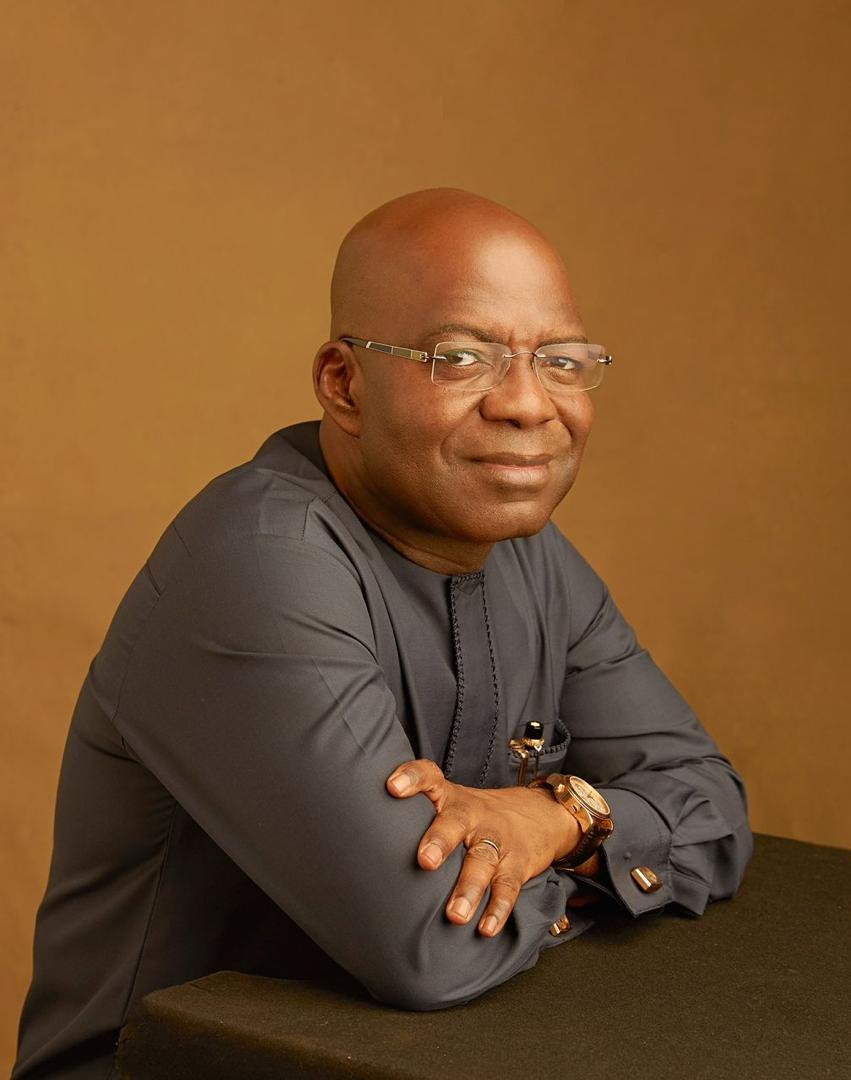
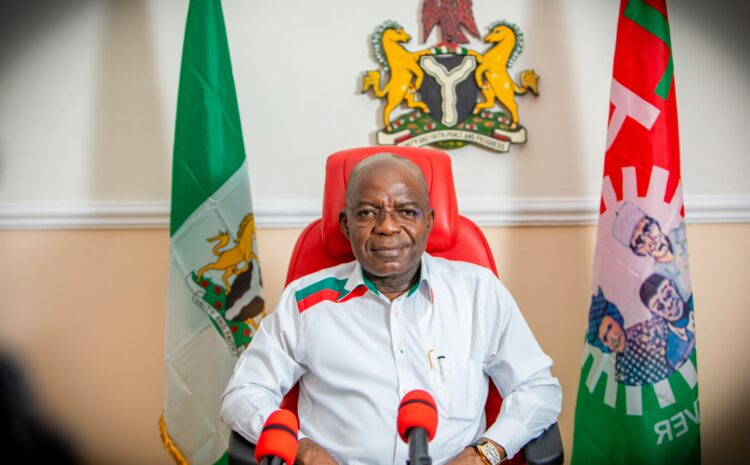
Governor Otti was the former Group Managing Director/Chief Executive Officer of Diamond Bank Plc (now merged with Access Bank), one of the leading retail financial institution of its time in Nigeria. He began his banking career in 1989 with the Nigerian International Bank, a subsidiary of Citibank New York, where he worked in the operations department. Thereafter he moved to the then Nigerian Intercontinental Merchant Bank Ltd. While at Intercontinental Bank, he worked both in the treasury and financial services unit as well as the corporate banking division. In 1992, he joined Societe Bancaire Nigeria Limited (Merchant Bankers), a subsidiary of Banque SBA Paris, where he rose to the position of a Senior Manager.
He moved on to the United Bank for Africa (UBA) as the Principal Manager overseeing the bank’s corporate banking sector for the entire South Division with the responsibility of growing the oil and gas business for the bank. In May 2001, he joined First Bank of Nigeria, PLC as Assistant General Manager with the sole responsibility of growing the Energy Sector for the bank. In April 2004, he was promoted to the position of Deputy General Manager, and a year later was appointed Executive Director, commercial banking. This was followed by a re-designation as the Executive Director south directorate, where he was responsible for over 140 branches in both the South-South and South Eastern geopolitical zones of the country.
In March 2011, he moved from First Bank Nigeria PLC to Diamond Bank as Group Managing Director/Chief Executive Officer and led the bank through a major transformation. Upon expiration of his first tenure, Diamond Bank renewed his tenure in March 2014 to an additional three years. On October 24, 2014, Governor Otti took voluntary retirement. Governor Otti’s time as the GMD/CEO of Diamond was described as the brightest years of Diamond Bank by His Royal Highness Igwe Nnaemeka Alfred Achebe, the Obi of Onitsha, who was then the Chairman of the Board of Directors of Diamond Bank.
In 2014, Governor Otti joined the race for the governorship of Abia State and became a gubernatorial candidate on the platform of the All Progressives Grand Alliance (APGA). He went on to win the election but was robbed of victory. On December 31, 2015, the Court of Appeal, which sat in Owerri, Imo State, declared Otti as the winner of the April 11 and April 25 Governorship elections in Abia State, removing the incumbent governor On February 3, 2016, the Supreme Court of Nigeria reversed the Court of Appeal’s verdict and affirmed the election of the incumbent as Governor of Abia State
Undeterred, Governor Otti continued his quest for the governorship of Abia State. In March 2019, he contested again on the platform of APGA and again, history repeated itself as he was rigged out. However, Governor Otti Triumphed in His Third Governorship Bid. This time he contested on the platform of the Labour Party and won with a landslide, trouncing the incumbent governor and his PDP candidate as well as the candidates of the All Progressives Congress and YPP, his closest rivals.
Governor Otti was a member of the Editorial Board of Thisday Newspaper, and wrote a fortnightly column, every other Monday, titled “Outside The Box”, on the backpage of the newspaper.
In 2009 he was conferred with an honourary doctorate degree by Babcock University in Ogun State, Nigeria, and in 2012, an honourary Doctor of Science (D.Sc.) degree by the University of Port Harcourt, Rivers State, Nigeria. In 2013, he received yet another honourary doctorate degree from the University of Nigeria, Nsukka in Enugu State, Nigeria.
Governor Otti is married to his wife, Mrs. Priscilla Chidinma Otti, and they are both blessed with three grown-up children.
Check out his Speeches here.
The manifesto of Dr. Alex Otti, titled “Rebuilding Abia,” is a comprehensive economic and social blueprint designed to transition Abia State from a “consumption-based” economy to a “production-based” one.
Below is a detailed breakdown of the core pillars and commitments outlined in his governance framework.
🏗️ 1. Vision and Mission
Vision: To restore the glory of Abia State and make her the “Number One” state in Nigeria.
Mission: To establish a responsive, efficient, and accountable government that sustainably develops the state for the welfare, security, and progress of all residents.
 📈 2. Economic Transformation & GDP Growth
Otti’s primary goal is to double the state’s GDP within his first few years through:
Geometric IGR Growth: Aggressively expanding Internally Generated Revenue (IGR) to reduce dependence on Federal Allocations.
Industrialization of Aba: Transforming Aba into a global industrial hub, specifically targeting the leather, garment, and fabrication industries.
Small Business Support: Providing soft loans and grants to artisans and Small and Medium Enterprises (SMEs) to stimulate local trade.
🏫 3. The “Social Contract” (Key Sectors)
Education (The Fulcrum)
Budgetary Commitment: Allocating 20% of the state budget to education (as seen in the 2026 budget).
Infrastructural Reform: Massive renovation of primary and secondary schools and the establishment of “Smart Schools.”
Scholarships: Regular funding for indigent but brilliant students via state schemes and the Alex Otti Foundation.
Healthcare
The Health Matrix: Investing in primary healthcare centers to ensure no Abian is more than 30 minutes away from a functional clinic.
Medical Tourism: Modernizing state-owned hospitals to discourage seeking medical care abroad.
Digital Economy
👷 4. Infrastructure & Environment
Strategic Road Networks: Building roads with high-quality materials and reputable engineering firms (moving away from “patchwork” repairs).
Geometric Power Support: Partnering with private power providers (like Geometric Power) to ensure 24/7 electricity for industrial clusters.
Urban Renewal: Cleaning up the state’s environment and implementing modern waste management systems.
🤝 5. Welfare and Security
Prompt Payments: A strict commitment to paying civil servants’ salaries and pensions on the 28th of every month.
Security: Strengthening local security architecture and using technology (surveillance) to protect lives and property, especially in kidnapping hotspots.
📜 6. The 25-Year Development Plan (2025–2050)
In late 2025, Otti signed a 25-year legally binding roadmap into law. This ensures that:
Dr. Alex Otti’s government has emphasized “community-centric” governance, shifting focus toward projects that directly impact the daily lives of residents in both urban and rural areas.
As of April 2026, here are the most significant community projects completed or currently being executed:
🏥 Healthcare & Social Welfare
200 Primary Healthcare Centers (PHCs): A massive project to rehabilitate, remodel, and retrofit 200 PHCs across all 184 wards in the state. These centers are being equipped with independent solar power and efficient water systems to ensure 24/7 care in rural communities.
Medical Missions: Regularly hosts free surgical and medical missions in collaboration with the Association of Nigerian Physicians in the Americas (ANPA), treating thousands of indigent community members for free.
Social Security for the Elderly: Introduced a social safety net program that provides financial and healthcare support specifically tailored for senior citizens in the state.
🏫 Education & Human Capital
Smart Schools Initiative: Constructing modern “Smart Schools” in various local government areas, featuring digital tools, science laboratories, and renewable energy to bridge the gap between rural and urban education.
Teacher Recruitment: Recruited over 5,300 teachers (with another 4,000 in progress as of early 2026) to ensure that community schools are adequately staffed.
Manpower Development: Committed ₦5 billion in 2026 for the training and retraining of public sector workers to improve service delivery at the local government level.
🛣️ Rural & Urban Infrastructure
The “Omenuko” (Igwu) Bridge: Commissioned in February 2026, this vital bridge in Ozu Abam (Arochukwu LGA) replaced a dangerous colonial-era structure. It was completed alongside the 30km Abam–Ndi Okereke–Arochukwu road, opening up agricultural communities to the city.
Aba Central Bus Terminal: A near-complete modern transport hub designed to restore order to community commuting and provide decent facilities for travelers and drivers alike.
Street Lighting & Sanitation: Implementation of widespread solar street lighting in Umuahia and Aba, coupled with a reformed waste management system that has significantly cleaned up previously neglected community markets.
⚡ Power & Water Schemes
Rural Water Schemes: Revitalized several dormant water schemes in various communities, ensuring that residents have access to clean, pipe-borne water.
Geometric Power Collaboration: While a private investment, the government provided the critical political and infrastructural “last-mile” support to ensure the Aba ring-fenced network provides steady power to local artisans and small businesses in the Enyimba city.